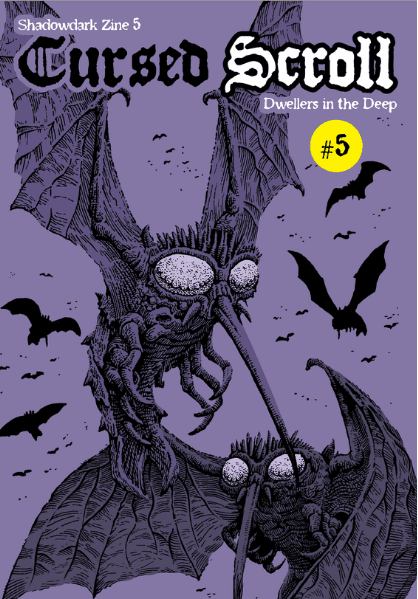
Today we’re looking at Cursed Scroll 5: Dwellers in the Deep by Kelsey Dionne. This is the latest release in Arcane Library’s series of zines that include classes, monsters, and adventures focused around a particular theme or region. In this case, the focus is a sort of underdark analog called Morzomotha and a huge dungeon for level 8 parties.
Let’s start wisely, as Tolkien did, with the map. Rather than an open overland area, Morzomotha is a labyrinth of caves with a hex map overlaid. Due to the nature of caves it doesn’t allow for the freedom of navigation that a typical hex map does – the party’s travels will be limited to the tunnels going in and out of each hex. For the most part, the map seems to have been carefully drawn such that the tunnels traverse the widest parts of the hex. But it does lead to some strange abstractions where the party may only take a path through one small corner of a hex but according to the RAW travel procedures, it will take the same amount of time and resources as if they had crossed the fattest part of the hex. Not a dealbreaker by any stretch, but it does raise the question of whether this would have been better structured as a point crawl.
So if you were hoping for a big sandbox or the Shadowdark version of Skerples’s Veinscrawl, this ain’t it. Instead we get something that is much more focused and much more finite. It is more of a macro dungeoncrawl than an underground hexcrawl. Although there are enough loops and branching paths to give the PCs a lot of options about where to go. It’s restricted, but absolutely not linear.
Random encounters are quite minimal, following the trend set by earlier issues of Cursed Scrolls. There are different tables for different regions, but each entry contains only the name of the monster and the number appearing. I assume this is due to the strict page limit. We don’t even get a handful of special encounters as we did in Cursed Scroll #4. But as I’ve said before, I would love to see more encounters like those found in the core book. Short and sweet but still describing a situation rather than just a name. The author also included 2d8 stingbats instead of 2d6, which I can only interpret as a personal slight.
The hex descriptions hit that goldilocks zone of being neither too long and difficult to grok nor too brief to provide the structure for interesting gameplay without tons of work from the GM. They’re also weird with tons of variety not just relative to each other but relative to other underdark-adjacent. Some of the old tropes are present but this isn’t Night Below with the serial numbers filed off. On the one hand you’ve got giant psychic crabs ruling over a wrecked galleon in a dried seabed. You’ve got 40 or so insane delvers engaged in a battle royale. And if you drop your dead companions in a particular hole they might get possessed by a reluctant but grateful archmage.
And on the other hand you’ve got the classics – duergar, mind flayers (sorry – brain eaters), beholders, etc. but they all have a little twist that will keep things interesting for veteran players. The duergar are being tormented by a sentient magic sword. Brain eaters practice a decadent religion of humanoid sacrifice and the beholder is none other than Shadowdark’s cover model (for plebeians that don’t have the premium edition), the Ten-Eyed Oracle.
Drow are noticeable only in their absence. Avoiding the underdark race with the strongest branding was an interesting choice. It leaves breathing room for Morzomotha’s stranger and more novel elements but a unique interpretation or at least some notion of how they fit into the setting would have been useful.
But getting back to hexes, the crucial thing is that they each have something for the PCs to do. There’s no useless lore or meandering descriptions of things the party can see but not interact with. The focus is on gameplay and something that will get the players making choices and rolling dice.
Let me give an example of one of the simpler hexes: “1010. OFFERING STATUES Six leering, bat-faced statues (gargoyles) perch at the point where the tunnel splits into two major arteries. Clay bowls of dried blood, bound skeletal remains, and four rubies (200 gp each) lie at their feet. An offering of living flesh or 200 gp sates the gargoyles, allowing safe passage.”
First of all, it’s brief. It takes 10 seconds to read. Second, it manages to tell a story and set up an interesting choice for the PCs in that time. There are rubies on the ground – it’s enticing. There are scary statues and skeletons – it’s also clearly dangerous. It almost demands interaction. I’ve seen too many hex crawls where the party travels through, the GM relays a boring description of the area, and then asks “do you want to do anything” and the answer is always “no” because no choices have been presented and then they move to the next hex and make a reddit post about how hexcrawls are boring and you should just skip travel.
I love it when designers set up consequences that reverberate well beyond the adventure itself and Cursed Scroll #5 delivers in spades. In one hex we read “Placing the books from hex 207 and 1404 on the altar releases a subsonic pulse felt by all beings. The two Lost deities regain their True Names and a shred of their former strength; their return has begun, and the world starts to remember them.” In another place the party might find a tear in spacetime that leads 10,000 years in the past. Or maybe they steal a book that begs to be returned to the library of Mordanticus the Flayed. It’s the kind of stuff that makes any campaign more interesting and unpredictable.
So although the hexes themselves are very strong, there isn’t much to tie it all together. No meta plots or scheming factions. Besides the books mentioned above, I don’t think there are any leads or hooks that will link multiple hexes together or push the PCs towards a specific location. We are given a rumor table but most of the entries are nonspecific and won’t engender much in the way of exploration. The most compelling reason to traverse Morzomotha is to visit the Library of Leng.
The Ghoulish Library of Leng is a 64-room, two level dungeon that is certainly the centerpiece of the whole book. Here the Librarians of Leng “catalogue the nightmares, terrors, and fears that flow through this dimension.” It’s a sort of Lovecraft/underdark mash up with unknowable cosmic horrors rubbing shoulders with deep ones and brain eaters.
The main theme of the library is books. Duh. But it has a seemingly endless supply of ways to make them interesting. There are books that will make you paranoid. Books that want to go somewhere. Books that grant boons. Books that will turn you into a wyvern. Books with people inside, and books that catalog the fear of every single mortal. And to cap it all off, there is a magic ink that can change almost any book. Imagine the shenanigans your party will get up to when they can make edits to a book that writes a demon’s biography in real time. It’s all incredibly imaginative and gives the idea of “emergent gameplay” a shot of adrenaline. The entire course of your campaign might be altered drastically depending on which book a PC decides to flip through.
But even if the entire party is illiterate, there’s plenty to do in here. Lots of HOTTness. I love the idea of a portcullis trapped with a toxin that makes you shout “Intruder!” for 1d4 rounds. And then you’ve got stuff like an alchemy room to experiment with, a nice trick where moving towards something makes it get further away, a few teleport traps and even a time dilation room. The sheer variety that The Ghoulish Library of Leng is able to maintain over 64 rooms is damned impressive. I’ve reviewed 10-room dungeons where the author struggled to fill half the rooms. Here, each one presents something for the PCs to interact with and from which fun conversations, choices, and consequences will flow freely.
Sometimes it does get a little funhouse – encounters like a robot goblin fortuneteller named The Great Zambini, an imp serving hors d’oeuvres, or a room full of magic mirrors infringe on the verisimilitude a bit. But overall the library maintains the sense of being a real place with its own sort of twisted logic.
The two primary factions in the dungeon are the Librarians of Leng and the Deep Ones. It’s a little unclear to me how they might react to the party’s presence in the dungeon. There is a factions section (from which the Deep Ones are strangely absent, but the books are included) and even a rudimentary order of battle for the Librarians. But it doesn’t really give me enough information about how each faction will respond to intruders. And the individual room keys provide some conflicting information. In some areas, Librarian guards will attack on site but in the areas just past them, the Librarians seem to be indifferent. The Deep Ones have the same issue – they seem to work for the Librarians and in some areas it’s clear that the PCs will be unwelcome. But in another area they might try to hire the PCs as sous chefs.
So it would be helpful to have some indication on the map of which areas visitors are tolerated vs areas where they are strictly forbidden. The good old reaction roll is always available, but it seems like there is some kind of intended structure that is just not communicated well enough.
The dungeon is also BYOH – bring your hook. We get a few rumors, and treasure is always a motivator, but if you want a specific reason for the party to explore this location, that reason will probably come from elsewhere in your campaign. Luckily the nature of this place, a vast library where virtually any information can be learned and where several rare artifacts are housed, should make that easy. It will also probably help determine if the party tries stealth, diplomacy or violence to meet their goals. All three methods are supported.
Overall, The Ghoulish Library of Leng is Dionne’s magnum opus. It’s not breaking any new ground but it is a tried and true formula in a high state of tune with the throttle floored. It has that rare combination of very strong fundamentals and endless creativity that will make it a joy to run and will surprise and terrify your players.
On a scale of 2-12, the hexcrawl gets 8 stingbats and the dungeon gets 11 stingbats, so Dwellers in the Deep gets an average of 10 stingbats.


Leave a Reply