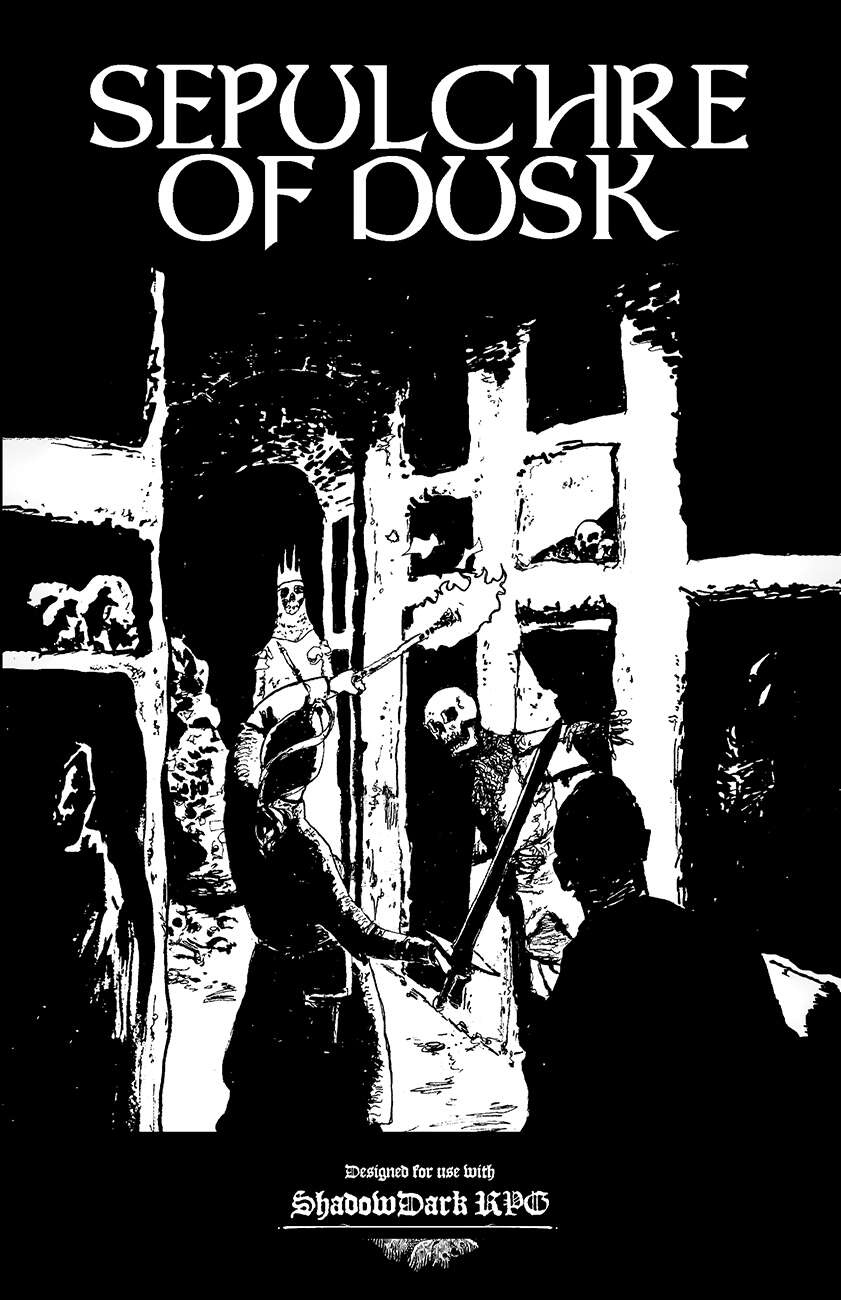
Today we’re looking at Sepulchre of Dusk, an “introductory” adventure by Scott Craig that consists of an 18-room dungeon. Introductory is a word which here means “level 1”. It’s a classic tomb-robbing, prisoner-rescuing, goblin-slaying romp.
The adventure begins in medias res. The setup where a bridegroom is kidnapped by goblins, the party investigates the ambush site and then arrives at the goblin camp is all presumed to have already happened. I would prefer these scenes to be played out but as it is, your session will begin with quite a bit of read-aloud. On the other hand, you can’t go wrong by starting your game night staring down a dark hole filled with monsters and treasure. So I won’t fault the author for this.
Random encounters are a mixed bag – a few nice ones but fewer than half are actual encounters and instead we get stuff like “A number of drowned rats float on the water here. A splash echoes from beyond the torchlight. If investigated, nothing is found, and roll on this table again” or “A nearby dark corner or burial niche is inhabited by a small rat swarm. If left alone, the swarm will not attack.” I think there’s a desire to write random encounters that slot very nicely into the environment of the dungeon and the inhabitants that are already there. And there’s nothing wrong with wanting a little consistency. But also, I would encourage adventure writers to get a little more weird with it and include a bit more variety.
The dungeon itself is a barrow underneath the goblin camp, consisting of 18 rooms. The room descriptions are, at times, on the longer side. Which is not to say they contain useless information or overly elaborate language. But some editing is definitely needed to get them to a length that players will be able to grapple with before their eyes glaze over. I would see what can be moved to the follow-up bullets and then get my red pen out and remove anything that isn’t strictly necessary. Give the GM something punchy to kick off the conversation, and anticipate and answer the questions that will come up in subheadings or bullets below. As it is you’ll want to employ a highlighter.
It’s a bit of a slow burn. The first ⅔ of the rooms are pretty light on encounters, but there are lots of hints and omens to find as well as a few treasures to uncover. It’s also a greatest-hits compilation of D&D dungeons – statues that come to life, yellow mold, blade traps, stuck and locked doors. Every room has a decent amount of things going on that will keep the PCs busy, even if it’s not blazing any new trails.
I really love this trap – “Bronze statue. A stern yet handsome woman. A BLUE LEATHER SLIPPER is grasped in the statue’s extended fist. This slipper faintly glows if detect magic is cast; it is the mate to the slipper in area 11. Trap: Approaching within reach of the damaged statue triggers this trap. The statue attempts to grab the PC’s leg; DC 15 DEX or 1d3 damage and immobilize. DC 15 STR to free PC or take 1d3 damage each round.”
It’s enticing – it’s holding a slipper that is certainly interesting even if you don’t know that it’s magic. It’s subtly telegraphed – the fact that it’s holding a slipper means it could have snatched it from somebody. And it will lead to some creative problem-solving as the players try to figure out how to get the slipper without triggering the trap. It’s not an arbitrary hp tax. It presents a risk and a reward and allows the players to make a choice. And players that deduce what the trap does and figure out a way to get the slipper will feel like a smarty-pants.
Conversely, we have things like this: “Green flame. Under several feet of water in the southeast corner of the room is a pedestal with a stone bowl emitting a green flame. Strangely, this magical flame is unquenched by the water and emits no heat. The bowl cannot be removed.” I’m not the most seasoned GM out there but I’ve been running the game long enough to know that the players will expect something to be up with that magical green flame. And they’ll spend 20 minutes trying to figure out what it is before I have to strongly hint that they should just move on. In this case there are similar altars found further in, but this not foreshadowing in any way that’s useful. Maybe I’m belaboring the point and maybe it’s fine if not everything has some kind of interactable reason for existing. But for something that obvious and enticing, I think there should be some kind of payoff, either for good or ill. But there are more than a few things in here that feel like they should be important but are not.
Things start to get spicy starting in room 10 with a magical fresco that can trap victims and force them into mortal combat with a beastman. If they fail they are trapped forever, if they succeed they escape clutching a hard-won treasure. I can see this scene playing out a few different ways and they’re all fantastic.
Also in this room is a magic weapon that is just *chef’s kiss*: “BRONZE GREATAXE (LABRIS THE BRIGHT, HEWER OF NECKS; +1 to hit; once per day after killing an enemy, brandish axe and bellow to force a morale check to all near enemies.”That’s the kind of weapon a PC will hang on to even after something more mechanically advantageous comes along. Great name, great benefit. And a great example why a simple “+1 greataxe” is a wasted opportunity to create something fun and memorable.
Following that we’ve got the ol’ wight in a sarcophagus with a few twists, some skeletons that come to life when disturbed, a sneaky ghoul, and a few more clever tricks and traps. The whole thing culminates in a jailbreak as the party frees the bridegroom from goblin clutches. There’s a bit of faction potential where certain goblins might be in favor of peace with the humans. Their inclination is determined by a random reaction roll, and one potential result is that both the goblins currently guarding and torturing the prisoners might be easily persuaded to let them go. That sort of about-face might be hard to sell, and this is one of those times when violence makes more sense and would be more satisfying. But at least the option for diplomacy is there.
Sepulchre of Dusk is nicely dense, with more packed into its 18 rooms than some dungeons with double that number. This means that you may need to spend a bit more time reading the room keys and preparing, and an attempt to run it off the page will result in a few too many long pauses and misunderstandings. But it’s worth the effort, I think. I should note that this was reviewed a few years ago at tenfootpole. Bryce took it to task for a confusing layout but this version has been revised. It’s not easiest dungeon in the world to read but it’s a big improvement over the original.
This would be a very strong adventure for 1st time players. It’s classic D&D adventure some aspects that are a bit traditional or even cliche, but are well-executed. Jaded veterans of the hobby might find it a little played-out, but newbies will appreciate that this is how they probably pictured the game in their minds. And the thing about “basic” adventures is that everyone thinks they’ve been done to death, so no one writes them. Well, here ya go. Basic isn’t always bad. Sometimes you just want a cheeseburger, and this is a damn fine cheeseburger.
On a scale of 2-12, Sepulchre of Dusk gets 9 stingbats.
https://www.drivethrurpg.com/en/product/431649/sepulchre-of-dusk-compatible-with-shadowdark-rpg
Leave a Reply