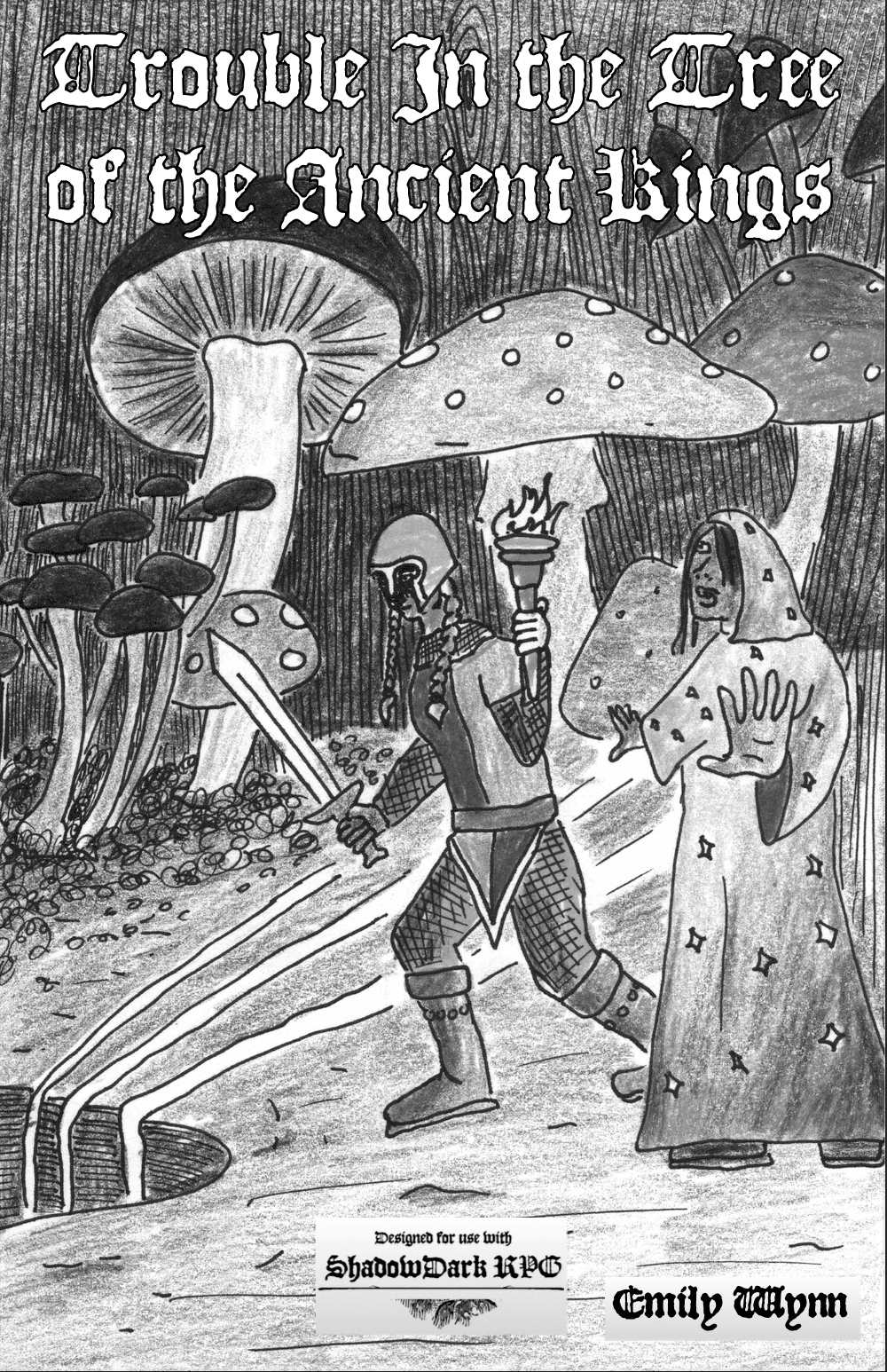
Today we’re looking at Trouble in the Tree of the Ancient Kings, a journey through a 32-room dungeon inside of a giant tree by Emily Wynn for levels 3-5.
A very old, very enormous tree with magical powers has begun to whither and brown out of season. Inside, an evil wizard has corrupted the trees sap to try and resurrect the mummified remains of an ancient kings. This has caused the tree to become infected with an enervating ooze. The PCs are asked to investigate.
The sort of side-elevation, sort of isometric map inside a giant tree is a highlight. It looks great and there are lots of loops and tunnels and verticality. There is also no scale provided so the dimensions of the rooms are anyone’s guess. Movement = time = random encounters = risk. When distances are handwaved you’re making it a bit more difficult for the players to gauge risk and make choices based on their assessment. It’s a small thing, but it all ties into the core systems of the game. There are also places where it is directly related to the mechanics of certain rooms. “A section of floor that has been rotted and then desiccated by the oozes. Any time a PC moves without checking, such as during combat, there is a 1:12 chance they step on the rotted spot. If a PC steps on it, the floor breaks away and falls to Room 31”. If something is gonna happen every time a PC moves, it’s important to know how many moves it takes to get across a room.
Inside the tree we have a few factions to contend with – its native inhabitants include populations of insectoids and shroomans. They both have great if perhaps a little cliched characterizations with interesting modes of communication and tables for random traits and quirks. So you might meet a shrooman that repeats the last word of what other people say or an insectoid with a bioluminescent abdomen. Inconsequential from a mechanical perspective but it’s nice to provide the GM with some ammo to make NPCs fun and memorable.
The problem is that the needs of the party and the needs of these factions don’t really intersect. They can’t really help the party get to the root (pun INTENDED) of the problem with the tree, nor do they really have any reason to interfere. They have nothing to offer and ask for nothing, just living their lives. I guess it makes sense in a naturalistic sort of way but it doesn’t provide a lot in terms of gameplay. I would like to see the players have to weigh the risks and benefits of siding with one faction over the other.
The factions really needed to be the heart of the adventure, because otherwise it’s a bit short on interactivity. Quite a few rooms are tunnels that contain only information on how to get to the adjacent rooms and some might have a pile of detritus to search for treasure. There are a few places where I feel like potential is wasted: we have a shrine to an insect god and a room full of differently-colored mushrooms. But there are no strange mutations to be gained from pledging your devotion to an strange deity, and no trippy effects from consuming any of the mushrooms. We’re halfway there, just need to flesh these things out a bit.
The stable master of the insectoids’ beetle mounts has lost a beetle and asks the party to find it. It only appears as a random encounter, so the only active thing the PCs can do to find it is… wait, I guess? A better solution would have been some method to track or lure it. Nothing stopping the GM from allowing this, but also nothing helping them. I think one of the jobs of a designer is to predict and facilitate potential solutions to problems like this.
There are some fun, dynamic elements worth mentioning, mostly in the form of giant animals. We’ve got a possum mama looking for her baby, a giant lizard, and a giant woodpecker. More than anything else, I think the presence of things like a rabid marsupial and a woodpecker spearing the PCs through the wall with its enormous beak will provide most of the excitement here. To that effect, the random encounter table, featuring these creatures and several other interesting situations, is one of the adventure’s strongest elements. I would probably increase the frequency from the suggested 1 per 3 rounds.
There are a few rookie mistakes and omissions. Non-standard DCs are everywhere. Treasure values are often missing. There are amber gemstones everywhere but no mention of their worth. One bit of loot the party may find is a “necklace carved with an image of an insectoid with butterfly wings and a wasp stinger”. I love the specificity. I would also love to know, specifically, what the value of the necklace is, in gold pieces. A poison effect lasts 1d4 minutes? Sounds like it’s time for a bathroom break. Perhaps that should be in rounds.
The big finale cashes in on the old “party shows up just as the ritual is being completed” trope. The wizard finishes animating the mummy and we get into a big battle. The wizard is level 8 and can summon a level 2 ooze every round, and the mummy is level 9, so it will be a tough one. There is a chance the party can seize the wizard’s staff and take control of the mummy, but this isn’t really telegraphed in any way. In fact, none of this is foreshadowed much. If the party talks to the insectoid priestess she will tell them about the wizard. But barring that, they will probably just show up in this room and roll initiative without ever really knowing what was going on. Bit of a waste as the backstory is kinda neat and Odium the Ooze Wizard could be a fun character.
In my experience, players like to be able to puzzle out what’s going on in a dungeon. They want some context to inform their decisions and they get a nice dopamine hit when they make connections that help them progress and overcome the dungeon’s obstacles. In this case I would set it up such that the PCs know who Odium is, and potentially what the staff does, before they meet him in person. I think that would enhance the climax quite a bit. After all, isn’t it more impactful to murder someone whose name you actually know?
Illustrations are done by the author and are charming in a DIY sort of way. Very reminiscent of early D&D. Even the cover hearkens back to In Search of the Unknown.
So we have some real creativity here, with the setting, the map, and some of the monsters. But it’s a bit undercooked. I think by integrating the factions into the situation and giving some solid reasons for the PCs to interact with them, as well as a bit more focus on interactivity outside of the factions, would earn this a couple more of the ol’ stingbats. But as-is, it’s a solid first effort and with a little work from the GM could certainly be a memorable couple of sessions.
On a scale of 2-12, Trouble in the Tree of Ancient Kings gets 6 stingbats.
https://plibplob.itch.io/trouble-in-the-tree-of-the-ancient-kings
Leave a Reply