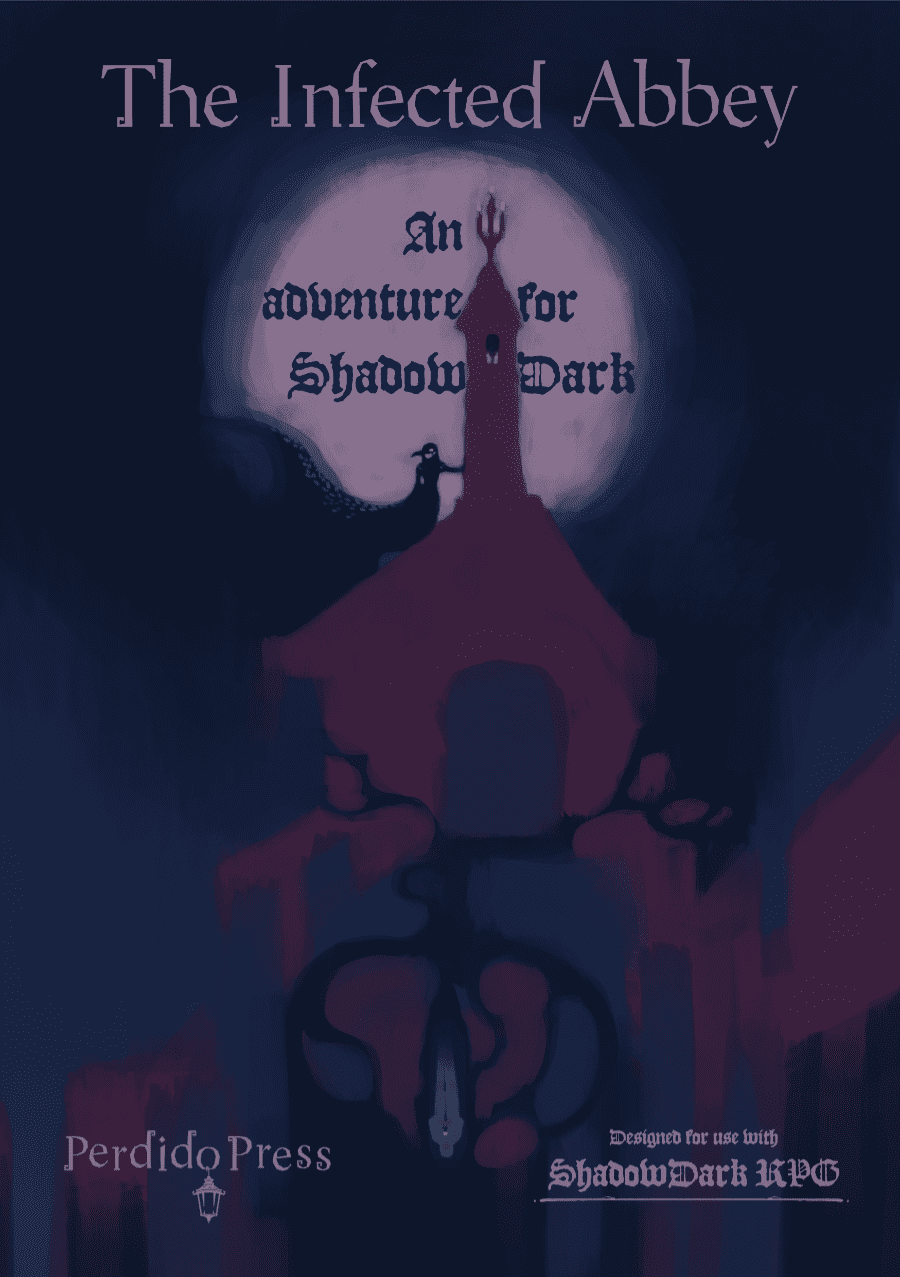
Today we are looking at The Infected Abbey by Perdido Press – an ambitious level 6-8 adventure in which players explore a ruined abbey overcome by a mysterious madness. The adventure features over 60 areas to explore, spread out over 3 levels of the abbey and the environs beneath.
A hundred years ago, the founder of Merondau Abbey, Saint Cerope, died. But in defiance of custom, Cerope was not cremated. Since then, his rotting corpse has spread corruption and disease throughout the abbey grounds. Along comes the party to put a stop to it. We have a few hooks for why they might be here – find an artifact, someone has gone missing, that sort of stuff. Or maybe they are on a holy mission to cleanse the abbey.
The adventure has a bespoke mechanic called Miasma. This is sort of a mist that mostly acts like darkness, but has a couple of special effects. One of those is called Grounded: “Spells and abilities that alter the environment always fail; e.g. passwall, hold portal, knock, control water, etc.” Look, spells aren’t free. There’s an opportunity cost to choose one spell over another at level up. Or finding a scroll is a reward for going on a delve and taking a risk. An adventure designer shouldn’t negate what the players have earned. Design with those spells in mind, and accept that they may allow the adventure to be played in a way that you didn’t envision. This is especially true of high-level adventures where the PCs will have abilities and magic that are impossible to predict. I would go as far to say that you could, for bonus points, design challenges that are meant to be solved with some of these exact spells. Make the player’s choice of a very situational spell count for something.
We also get a note that says “The grounded property is optional if using the miasma. It is helpful for maintaining the adventure’s balance, but hallowed ground makes it technically unnecessary.” Hallowed ground is a whole other thing. Certain areas of the adventure are protected from all physical harm and manipulation. Also you can’t teleport into these areas or even climb into them. This is the designer’s way of saying “I have decided how I want you to solve this challenge, and I’m not allowing you to do it any other way.”
I’ve talked about “magic doors” that can only be opened by a specific key or method before. Even though they don’t exactly align with my belief that open-ended problems should be the mainstay of dungeon design, they are a valid method for gating certain areas and can promote thorough exploration when used properly. But as the PCs level up, the contrivances needed to make magic doors work multiply. And if you get to a point where you need to ban entire swaths of spells, or the act of climbing itself, you need to take a step back.
Nerfing the PCs in a blanket way, like the Miasma and Hallowed Ground do, needs to be done very judiciously. If your adventure is too easy or “imbalanced” when they use perfectly level-appropriate spells and abilities, the answer is not to make the PCs weaker, it’s to make your adventure stronger. If you can’t think of a way to do that, it should be a lower level adventure.
The other feature of the miasma is that it can infect players with a disease called “La Cantata”. Infected players must pass a DC 12 CON check each day or take 1d4 WIS damage. On success they are cured. At 4 or less WIS the disease is permanent and the character is effectively retired. There are monsters that can either infect or cure PCs.
The adventure begins after 31 pages of new mechanics, magic items, magic and monsters. I’d prefer to have all the magic items and monsters at the back and for the adventure to come first but at least the table of contents is hotlinked so it’s easy to navigate. There are no page numbers in the table of contents, however. So if you printed this out you’re outta luck.
There is a very useful part of this section called “Keys and Tradeables”. This is a list of basically every item in the adventure that has a connection to another location. The key found in room x opens the door in room y, or the macguffin in room a can be given to the NPC in room b. There are 11 such items so having a reference like this is very handy.
The abbey itself is a very well-realized place with lots of interesting details that tell the story of the location. Engaged players will find a lot to learn and a lot of little connections that might not be terribly impactful but do a great job of creating immersion nonetheless. For example, there are some hints that a baby bird that makes its home in the chapel might be a descendant of Haribon, the Great King of Birds. It’s not that relevant to matters at hand, but would be a very cool mystery to piece together, and might have impact outside of this adventure. There are quite a few of these little easter eggs that give the sense of a place with real history. The themes of the location are strong throughout.
The goal of the first 15 areas is to talk to a nun named Annalisse. She tells you to kill her La Cantata-infected sister Natileth, who carries the key to the chapel. Natileth has some strangeness with her stat block. She’s level 12 but only has 2 attacks +6 for 1d8 damage each. Compare that to some of her level 12 peers like the Storm Giant (3 attacks +10, 2d12 damage each) or Swamp Dragon (3 attacks +8, 2d10 damage each). She also hugs you if both attacks hit, draining 1d4 WIS each round. It’s unclear, narratively, why this hug drains Wisdom or how the GM should describe that. She has two spells, the highest of which is level 3. In one, the target takes 1d8 damage per round until they “repent”, which takes an action. Again, it’s unclear how that works narratively. Does the target know they need to repent? How? So she’s clearly underpowered for a level 12 foe, and her abilities might be hard to explain in-world.
Another boss, the level 10 Mad Abbot, is similarly challenged. He has only two attacks +3 at 1d8 damage each, he’s down a few hp from what Shadowdark monster math would give him, and his spells are pretty weak. His best move is to resurrect some minions. Other than that he can immobilize someone for one round or do 1d10 damage. Compare that to the level 10 Archmage that can cast Deathbolt, Fireblast, Fly, etc. Just about all of the NPCs and monsters could use a rework to bring them in line with expectations for Shadowdark stats.
The majority of the gameplay here is fetch quests. An NPC tells you to go find something and bring it back. Or they hit a locked door and need to go find the key. The NPC quests break up the somewhat linear progression through the dungeon. I don’t actually have a problem with this, per se. As much as we hold up player agency as an ideal, most of the folks I’ve played with like having a clear, sensible objective vs getting dropped into an adventure site with total “freedom” to do whatever they want. But I do take issue with how most of these objectives only have one solution. That’s kind of the nature of fetch quests. You need to get the candelabra from Natileth – that’s gonna be a pitched battle where you take it from her corpse. We aren’t really given any other options. There’s no way to cure her madness or negotiate with her as written. Or go get the book from the drawer. Get the key from the corpse. Etc.
So the puzzle becomes figuring out what to do, rather than doing the thing itself. This is challenging as a designer. If things are too obscure, the players get frustrated when they don’t know what to do. Too obvious and you take away the challenge that makes figuring out the dungeon satisfying. The author has erred on the side of making things somewhat obvious – there are notes scattered around that explain things pretty clearly and helpful NPCs will provide information. I think this was the right move – again, all but the most dedicated players prefer to have some semblance of where they should go. But I would prefer if the author didn’t back themselves into this corner in the first place, by providing a greater variety of interactions with a multiplicity of potential solutions.
That being said, there is a tremendous amount of interconnectedness, and I love to see that. It will help keep things moving from moment to moment and incentivizes thorough exploration of the dungeon. It marks the difference between a dungeon that was designed and one that could have been rolled on random tables.
In the final room the party will face off against Saint Cerope’s infected champion before they find his corpse, the source of the abbey’s affliction. From Cerope’s mouth grows a single flower. The adventure asks, in bold text, “What will you do with it?” The petals of this flower can cure any disease or affliction. If the PC plucks the flower, Cerope’s soul is released and the abbey is cleansed. So I guess the choice is, exploit the flower for its petals and keep the abbey infected, or cleanse the abbey. But it’s not really a choice because none of this is explained to the PCs anywhere. There’s an opportunity here for a powerful dilemma, but there’s just no good reason to leave the flower. Even if someone near and dear to the party can only be cured by it and they had full knowledge of its powers (which they don’t), it only dies if they pull all 5 petals. So that means they can cure up to 5 people, and then when the flower dies the Abbey is cleansed anyways. That’s what we call a win-win.
I was also a bit let down that there was no big reveal about just why Saint Cerope chose not to be cremated and instead allowed his festering remains to cause untold suffering. But all we learn is that this happened “ for reasons unknown”.
There’s also a hidden, optional area called The Cavaerns of the Worm. Caverns is spelled “cavaerns” throughout. Google insists this must be a Roblox reference. The caverns have a very cool, otherworldly “place that time forgot” kind of vibe. They also have some decent loot. The party might learn about this place from the “worm girl” that haunts the abbey grounds looking for worms to feed her pet baby worm. If the party fetches some things for her she will make them a magic necklace that heals 1d6 damage when you eat a pound of dirt. Or if you bring her blood from the level 20 giant worm that lives down there, your reward will be that it heals 1d8 damage instead. What a bargain.
There’s a lot to do in the Infected Abbey but I think it will move quickly. There is a risk of players getting bored with a 60-room location but there is enough direction and variety to keep things fresh. But some folks might be frustrated by the restrictions that have been placed on their problem-solving. There was obviously a ton of effort and care put into this. Give the monster stats a once-over, maybe flesh out the story of Cerope and the flower a bit, and I think the right table would have a lot of fun with this.
On a scale of 2-12, The Infected Abbey gets 7 stingbats.
Leave a Reply