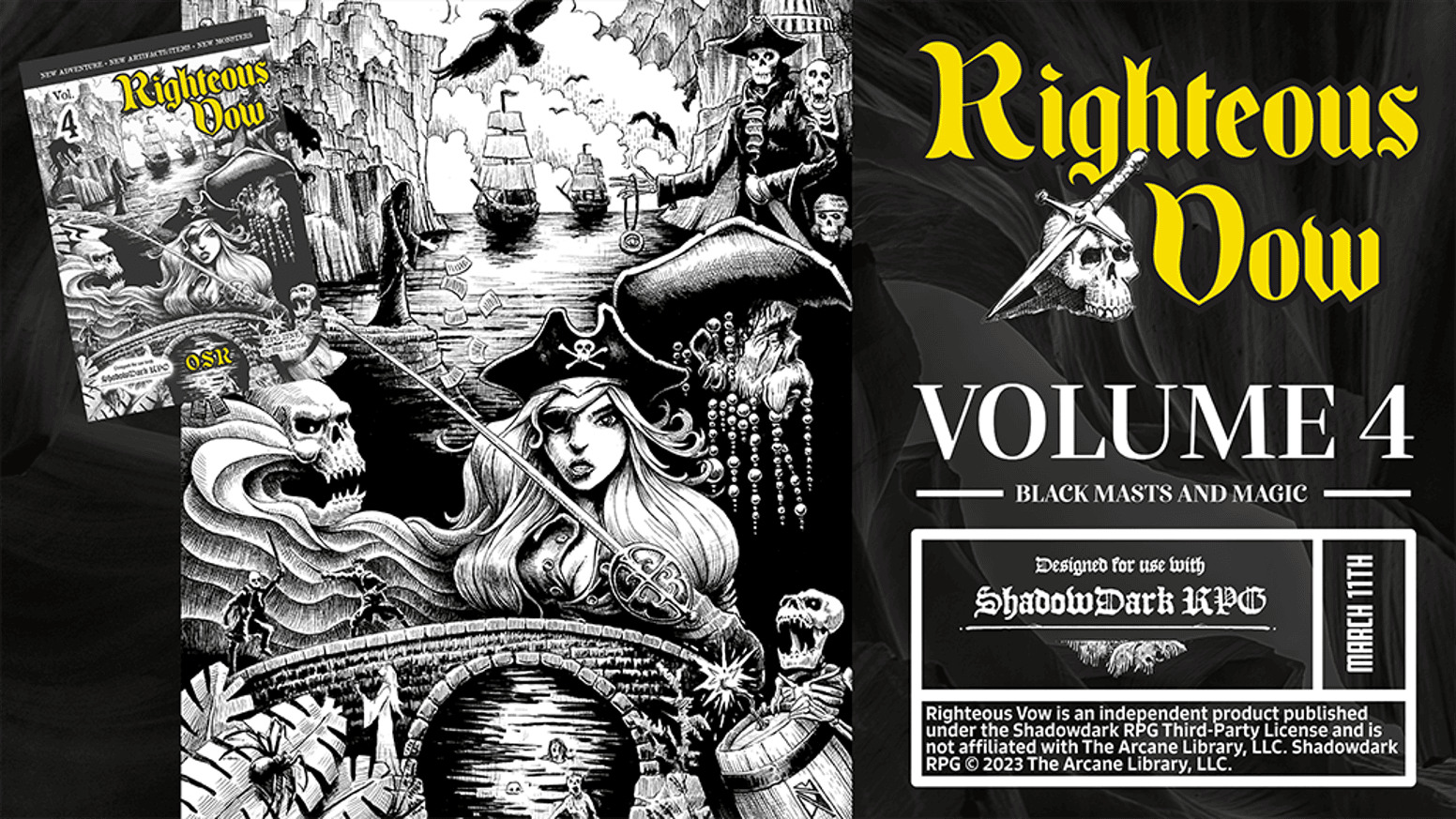
Today we are looking at Righteous Vow Vol. 4 – Black Masts and Magic, an adventure path for Shadowdark for levels 1-6 by Bill Harvat. The theme of this one is pirates. I was gonna say that pirates are so hot right now but Treasure Island was written in 1883 and I feel like they’ve been pretty popular since at least then.
The setup is that a very long time ago a really bad guy named Orchal was imprisoned and he found a penpal named Skalith. Skalith learned that he has to have 5 artifacts in order to free his buddy and our adventure begins shortly after the first artifact is unwittingly discovered by the captain of The Sea Monkey, where the PCs are currently serving as crew members. The structure of the campaign then, is to sail from place to place, collecting the artifacts, dodging Skalith and other unscrupulous foes, and finally dumping the artifacts in a magic cauldron to destroy Orchal forever.
We open with a sort of cutscene. The artifact, a sentient talking skull, projects an image of Skalith so he can monologue a little bit, and then the party fights some zombies. When all is said and done the party will have a fully crewed ship, a ragtag group of NPC followers and a map to the artifacts.
Unfortunately some of the NPCs, particularly the skull Karg, act as fonts of exposition. Instead of building the world so that the PCs can learn about it through exploration and observation, key plot points are just handed to the party at opportune moments. Feeding information to PCs via NPCs isn’t bad per se, but the convention is a bit overused here.
So far we have an opening cinematic and tutorial combat. It feels a bit videogamey. A more favorable term would be “narrative”. I am not making a value judgement here. This sort of adventure path with a clear direction and clear goals is what a lot of tables are looking for. Whenever they show up on the Shadowdark discord server they get pounced on and told that they should want “emergent gameplay” that’s “player-driven” and that instead of a long-form narrative campaign they should “prep situations instead of plots”. I am guilty of this myself.
Black Masts and Magic is not an OSR sandbox and it’s not really trying to be. Yes, it does have a big open sandbox but there’s a pretty clear path that things are expected to follow. Get the artifacts, dump them in the cauldron, save the day. This is broken up into 5 adventures, the first of which involves the aforementioned scene with Skalith and then a visit to town for some exposition and a few NPCs.
Adventure #2 takes us to a volcanic island. This and all of the other adventures have a small island to explore with its own encounter tables and several points of interest. There is a bit of a disconnect where the islands are placed on a larger hex map, but the maps of each island don’t have any kind of scale that you could use to determine travel times from one location to another. The locations themselves have some interesting encounters or describe short dungeons that the GM might flesh out and are described with greater detail than you might find in a Cursed Scroll hex key.
The centerpiece of #2 is the large 44-room volcano temple where the artifact is hidden. The first floor has a nice mix of HOTTness with traps and secrets being described well enough that interaction can go beyond a simple dice roll. One trap involves a pile of coins on a plate – remove the coins and a gas starts pouring out the mouth of a naga statue. By being specific about how the trap works, rather than abstracting it to “poison gas trap, DC 12 DEX to disarm” you give the players the opportunity to get a little creative – replacing the coins with something of equal weight, blocking off the statues mouth, etc.
But the real fun begins after the party nabs the staff and the volcano starts erupting. We get a round by round schedule to track the rising lava, but the upshot is that the party will need to climb up to get out. The adventure provides a few different avenues, each with different risks. The timeline for escaping is tight and this will be a nail-biter. I think it might have been good to foreshadow the eruption a little bit, but the existence of a volcano foreshadows eruption by itself, and it’s certainly a trope so most players won’t be surprised. But the opportunity to plan the first few steps of an exit would certainly be welcome.
Regardless, this is a fun dungeon and even if you’re not interested in running the entire adventure path, it could be worth grabbing for your own pirate or jungle-themed campaign. It’s also very modular and you could swap in whatever artifact suits you.
For adventure #3 the artifact is in the hands of a siren queen that is using it to control a giant sea hydra. How the party obtains it is up to them – negotiation and subterfuge are certainly options, but the most favorable results will come through violence. This is probably the weakest of the adventures – battling the hydra will certainly be an event but there isn’t much to do besides harrassing the local fauna and maybe having a chat with the queen.
In adventure #4 the artifact is in the possession of a giant crab named Sarton that lives in an 8-room lair filled with gricks and explosives. Here and in other places, there’s a lot of what they call “yellow paint” in the video game biz. The adventure goes out of its way to signpost interactable objects, to the point of strongly suggesting solutions to certain problems. Inside the crab cave, we read “Goods. Most of the crates are filled with long-spoiled food, some rusty tools, and deteriorating linens. There are also 6 tightly sealed, wax-dipped barrels of black powder. Each barrel can be combined with some of the old linens to create fuses, and the barrels can be rolled down the ramps to explode near Sarton.“ The designer has a pretty clear intent here of how the barrels are meant to be used, which leaves the GM to fight against the text to present information in more neutral way that will allow the players to come up with their own solutions.
This is also when I’m going to bring up unnecessary skill checks – DC 15 to locate trip wires, for example, where I would probably just rule that if they look in the right place for them, the PC finds them. In another place we get this: “Six tightly sealed, wax-dipped barrels of black powder are tucked into a recess along the cavern wall. The cache sits beneath a section of ceiling crowded with massive stalactites. Any character who succeeds on a DC 12 INT check, notices that the rock formation above is unstable and could collapse if subjected to a strong shock or vibration. Any character who succeeds on a DC 12 WIS check realizes that igniting the powder would likely trigger a devastating explosion, bringing down a large section of the chamber in a massive cave-in.”
There are a few reasons I don’t like this. One is that these checks would likely be triggered by the GM rather than the player, and that’s backwards. The other is that, after the GM describes the room and asks for an INT check, if the PC fails they know they’ve missed something but won’t ever know what. And if they succeed, the GM basically gives them a huge hint and robs them of the opportunity to ask questions, gather information and draw their own conclusions. Better to just allow the players to ask questions and answer with generous information, rather than to answer unasked questions based on the roll of a die.
Sarton’s hoard has about 12,000 gp. It’s only level 6 and could probably be killed head-on by a clever or lucky level 2-3 party (look how many level 1 parties have slain the scarlet minotaur) but the adventure also provides a lot of alternate routes to victory. There’s this tension between the way treasure boards are depicted in fantasy art, with dragons sitting on literal mountains of gold and the way it’s depicted in fantasy ttrpgs where a dragon is curled around a mason jar filled with 300 gp, especially ones where gold = xp. Clearly the designer here is trying to emulate the genre, but dropping 12k gp into the campaign will certainly have some consequences. The pirate captain that’s ubering the party around would probably kill them in their sleep, fill the hold and sail off into the horizon. Even if the party manages to get it back to town without becoming sharkfood, they can carouse with a maxed bonus 6 times. This is a difficult to problem to tackle in general, so the GM is gonna have to think this through carefully.
The 5th and final adventure takes us to the Pyramid of the Wind Spirit where lies the cauldron that can put Orchal to bed once and for all. This dungeon is not as strong as the volcano temple. There’s a few good traps and hazards but they are vastly outweighed by the piles of loot that seem to choke every room. Still it’s worth mentioning my favorite trap – there’s a bookcase housing a book called “The Wondrous Book of Traps.” If it’s pulled, a trapdoor opens and drops the PC into a pit of acid. You can’t say you weren’t warned.
But instead of a dramatic battle through the pyramid it’s going to be more like Supermarket Sweep as the PCs load up their gear slots with the abundant magic items that lie mostly unguarded. And there’s a good chance the whole thing could be pretty anticlimactic. The BBEG, Skalith, will only be here if the adventure’s clock, the Timeline of Destruction, is far advanced. The timeline advances through random encounter rolls and as the artifacts are collected. So there’s a chance that quick and cautious parties with lucky rolls might dump the artifacts into the cauldron unopposed. Most GMs will probably want to place Skalith in the pyramid regardless. But also he’s a single level 11 monster against a level 5 party stuffed to the gills with powerful magic items so maybe give him a healthy contingent of minions as well.
There’s a sort of rollicking fun that permeates the book as it recalls the best bits of movies like Pirates of the Caribbean, Indiana Jones and Goonies along with an appropriate dose of the Monkey Island video games. The writing and design miss the mark in a few places but the adventure moves quickly and confidently and doesn’t take itself too seriously.
Production value is high. Art is beautiful and abundant. Layout is, for the most part, very clear while being attractive. There is a bit of wonkiness to individual room descriptions. Bolded terms in the room description don’t always show up in the bullet points below it, or the connection between the description and what’s in the bullet points is a bit tenuous. Take room 5 of the volcano temple – it has no bolded words in the description and the first bullet is labeled “Casket”. “Casket “ does not appear in description but “sarcophagus” does, so that should have been bolded and repeated in the bullet label. There is also a bit of blending between GM and player-facing info in those initial descriptions. They are written like read aloud text except that from time to time they will include things like “The door can be forced open with a DC 12 STR check.” That’s probably information that GM would typically reveal after a PC attempts to force the door. Also monster stats are all in the front, so there’s a lot of flipping back and forth.
And it is here at the end of the review that we must face some uncomfortable truths about ourselves and our little corner of the hobby. There is a difference between the kind of sandboxey, completely open-ended, player-driven adventure that GMs who read blogs, hang out on niche discord servers, quote the “Quick Primer for Old School Gaming” like it’s scripture and endlessly debate TTRPG philosophy want to run, and what most players actually want to play. They want freedom in choosing how their characters solve problems within the scope of an adventure, but they don’t necessarily want to be dropped on a big empty map and asked “where do you want to go?” There are certainly some players that will engage with that kind of game but there are also a lot that just want to have very clear goals and objectives.
Black Masts and Magic is for the latter type of players, and for the most part it will serve them very well. There are some well-designed dungeons and scenarios supported by a cast of colorful NPCs and nasty villains. There’s enough going on on each of the islands to fill the gaps between artifact quests and it’s all flavored pretty well. There is an awful lot packed into these pages but my Google analytics tells me you all spend about 3 minutes reading per article and I’ve already sailed past that metric so I won’t bother recounting it all.
So I think your enjoyment of this book will depend on your use case. Tables that want to run it as intended – as a structured, narrative adventure path – will find that it’s more than the sum of it’s parts. Those that want to part it out and grab the best bits for their own campaign will find a few solid dungeons and points of interest along with new monsters and magic items that are crafted with enthusiasm and are, most importantly, fun.
On a scale of 2-12, Righteous Vow Vol. 4 – Black Masts and Magic gets 8 stingbats.
https://www.kickstarter.com/projects/crawlclub/righteous-vow-4-a-rpg-zine-for-old-school-gaming
Leave a Reply